How to Use HS Codes to Understand Global Demand for Your Products
HS codes form the global language of traded goods. By understanding their chapters, structure, and logic, SMEs can interpret how products are classified, compared, and positioned in global value chains. This knowledge reveals patterns of demand and industry evolution.
Agustin Baldovino
CEO Sales in a Box AB
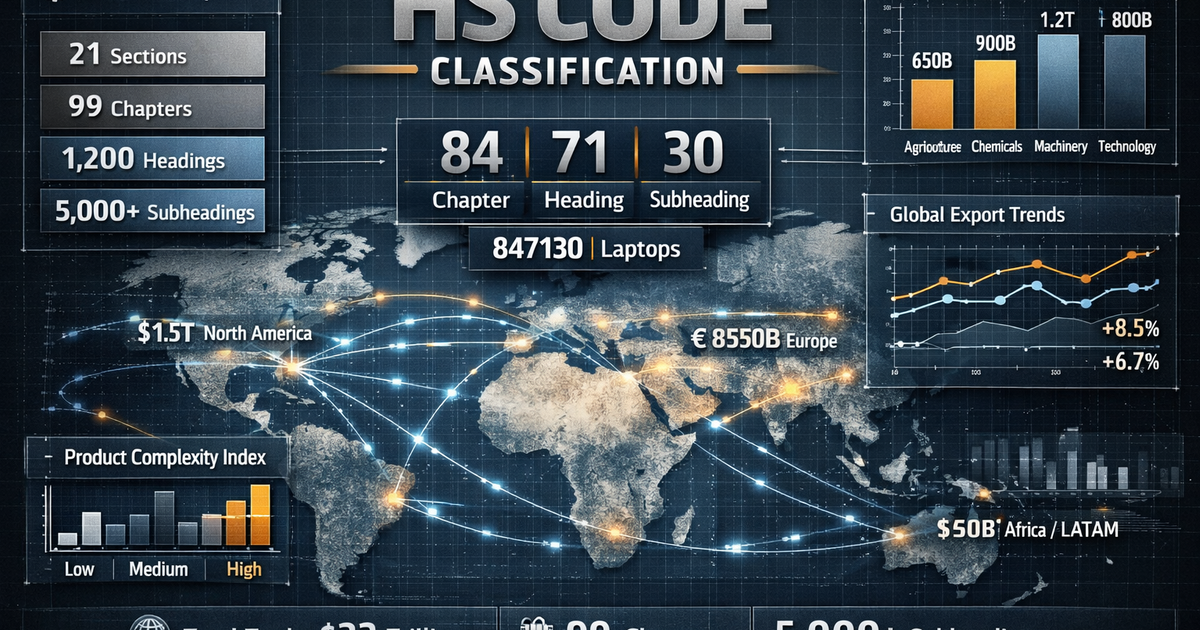
An educational analysis into the logic and structure behind the Harmonized System.
Every traded product must fit somewhere, and in global trade that “somewhere” is usually defined by an HS code. The Harmonized System, developed by the World Customs Organization, is the classification framework customs authorities use to identify goods across borders. That may sound technical, but the basic idea is simple: if you want to understand how products move internationally, how demand is measured, or how your own offering is categorized in trade data, HS codes are one of the most useful starting points.
What makes the system useful is its structure. HS codes are built in layers, moving from broad product groups to more specific product definitions. You do not need to memorize the full system to get value from it. What matters is understanding the logic behind it: the first digits place a product in a larger category, and the following digits narrow that category until the product type becomes much more precise. That structure is what allows companies, analysts, and public authorities to compare products consistently across countries.
A simple way to think about it is that the system starts wide and becomes more detailed as you move down. Chapters describe broad product areas, headings narrow things further, and subheadings define a more specific product type. One practical example is that chapter codes use 2 digits, heading codes use 4, and subheading codes use 6, with each step adding more precision.
For example, the hierarchy becomes clearer when written out in plain text. At the chapter level, the code uses 2 digits to define a broad product group, such as 84 for machinery and mechanical appliances. At the heading level, 4 digits are used to identify a more specific product family, such as 8471 for automatic data processing machines. At the subheading level, 6 digits provide a more detailed product type, such as 847130 for portable digital automatic data processing machines, including laptops.
This hierarchy is one of the reasons HS codes are so powerful. Once products are classified in a consistent way, trade flows can be tracked, compared, and interpreted on a global scale. That is useful not just for customs processing, but also for market analysis. If you are trying to understand where demand exists, which countries are active in your category, or how a product group is evolving over time, HS-based trade data gives you a shared frame of reference.
The overall system is extensive, covering 21 sections and 99 chapters, from raw materials to highly specialized manufactured goods. In practice, that means products are not grouped randomly. They are usually classified by what they are, what they are made of, what they do, or how far they have been processed. That makes the HS system useful beyond compliance. It also reflects how industries are organized, and that is part of why it works so well for commercial analysis.
You can see this logic in the chapter ranges themselves. Early chapters cover animal and vegetable products, later ones move into minerals and fuels, and then further into machinery, electrical equipment, instruments, and other advanced goods. That progression is practical, but it also says something about economic complexity. Countries exporting mostly primary goods often appear in very different parts of the classification system than countries exporting advanced machinery or precision equipment.
That is why HS codes matter for more than labelling. At a detailed level, they can help show where a country is specialized, how advanced its export mix is, and whether it mainly participates in trade as a supplier of raw materials, components, or finished goods. For anyone working with market intelligence, this makes HS codes less of an administrative requirement and more of an analytical tool.
For SMEs, this matters more than it might seem at first. Understanding the logic of HS codes helps you see how your product is understood internationally. It can help you benchmark against similar exporters, identify relevant markets, and make better sense of trade statistics that would otherwise feel abstract. It also improves communication with customs brokers, distributors, and partners who rely on the same product language.
Another important point is that the HS system is updated over time. New product categories are added as technology and trade patterns change, while older classifications are revised when they no longer reflect how goods are bought and sold. That ongoing maintenance is part of what keeps the system useful. It is not just a static customs reference; it is a living framework that continues to shape how global demand is recorded and interpreted.
In the end, the value of HS codes is that they help turn trade data into something readable. They give structure to product categories, make international comparisons possible, and offer SMEs a clearer way to understand where their products sit in the wider market. If you want to use global trade data to spot demand, benchmark competitors, or improve your market focus, learning the logic behind HS codes is a very practical place to begin.
Sources
- World Customs Organization (WCO) – Harmonized Commodity Description and Coding System Overview https://www.wcoomd.org/en/topics/nomenclature/overview.aspx
- World Trade Organization (WTO) – Trade Classification and Statistical Frameworks
https://www.wto.org/english/res_e/statis_e/trade_classifications_e.htm
- UNCTAD – International Merchandise Trade Statistics Concepts and Definitions
https://unctad.org/publication/international-merchandise-trade-statistics-concepts-and-definitions