Market Entry Models Explained: Distributor, Agent, Subsidiary, Joint Venture — Which One Fits SMEs?
Market Entry Models Explained: Distributor, Agent, Subsidiary, Joint Venture — Which One Fits SMEs?
Agustin Baldovino
CEO Sales in a Box AB
Market Entry Models Explained: Distributor, Agent, Subsidiary, Joint Venture — Which One Fits SMEs?
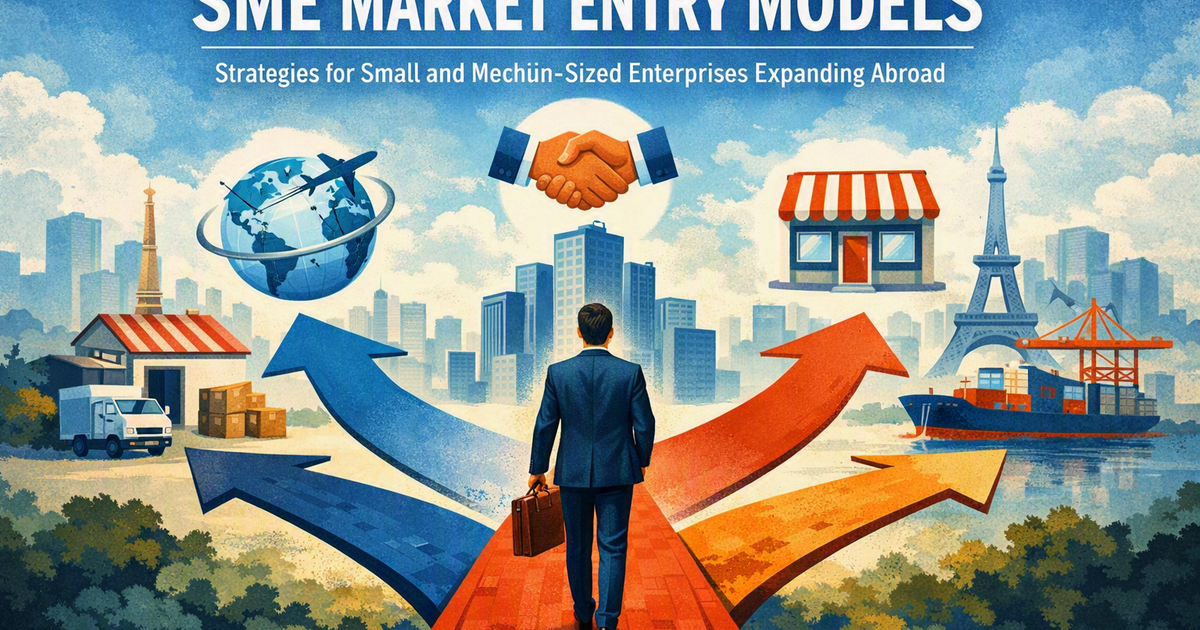
Small and medium-sized enterprises (SMEs) increasingly look beyond domestic markets to grow revenue, diversify risk and access global value chains. Yet internationalisation is not simply a sales decision. The market entry model chosen determines the level of control, capital commitment, legal exposure, learning, speed and strategic flexibility available to the firm. For SMEs, this choice is especially important because resources are limited and mistakes are costly. Unlike large multinational enterprises, SMEs often cannot absorb long periods of underperformance, complex compliance failures or poorly selected partners. This paper explains four common entry models—distributor, agent, subsidiary and joint venture—and evaluates which model best fits SMEs under different conditions.
1. Entry Mode Choice and the SME Constraint
Market entry modes differ mainly in three dimensions: control, resource commitment and risk. Low-commitment modes such as distributors and agents provide rapid access and limit costs, but reduce control over customers and market information. High-commitment modes such as subsidiaries provide stronger control but require capital, management capacity and tolerance for regulatory exposure. Joint ventures sit between these alternatives because they share ownership, risk and local knowledge with a partner. International business research commonly treats entry mode choice as a strategic decision that affects performance, risk-bearing and control over foreign operations (Anderson and Gatignon, 1986; Hollender, Zapkau and Schwens, 2017).
For SMEs, the decision is shaped by constraints more than by ambition alone. Studies on SME entry mode choice show that limited financial and managerial resources make SMEs more dependent on available capabilities, partner access and incremental learning than larger firms (Lin and Ho, 2019). European policy sources also emphasise that SMEs face barriers such as administrative complexity, high delivery costs and difficulty identifying reliable foreign partners (European Commission, 2026). Therefore, the best entry model is not the one that looks most sophisticated, but the one that fits the firm’s product, objectives, risk appetite and ability to manage foreign operations.
2. Distributor Model
A distributor buys goods from the SME and resells them in the foreign market. The distributor usually handles local sales, warehousing, customer relationships and sometimes after-sales service. This model is common in goods-based industries because it gives the SME immediate access to local networks without building a direct legal presence. The SME’s revenue comes from selling to the distributor, while the distributor earns the margin between purchase and resale price.
The distributor model fits SMEs seeking fast, low-cost internationalisation. It is useful where market demand is uncertain, local logistics are complex, or the SME lacks foreign sales staff. The main advantages are lower fixed cost, lower administrative burden and transfer of many operational tasks to the local partner. It can also reduce credit and inventory risk if the distributor purchases stock outright. For early-stage foreign expansion, this makes the model attractive because it allows market testing before deeper commitment.
However, the distributor model reduces control. The distributor may prioritise other brands, underinvest in promotion, discount excessively or fail to communicate customer feedback. The SME may also lose visibility over end users, making it harder to learn from the market. Contract design is therefore critical. The agreement should define territory, exclusivity, minimum sales targets, brand standards, reporting duties, service obligations, termination rights and rules for intellectual property. A poorly monitored distributor can create dependency and damage the brand while appearing cheaper in the short term.
3. Agent Model
An agent represents the SME in the foreign market but does not normally buy and resell the product. Instead, the agent introduces customers, negotiates or facilitates sales and receives a commission. The contract is usually between the SME and the final customer. This gives the SME more direct contact with customers than a distributor arrangement, while still avoiding the cost of a full local operation.
The agent model fits SMEs whose products require explanation, technical selling or relationship-based business development. It can work well in business-to-business markets where the SME wants to keep pricing, contracting and customer data under its own control. Compared with a distributor, an agent can provide better market intelligence because customers remain visible to the SME. The model also limits fixed costs, since remuneration is often commission-based.
The weaknesses are legal and managerial. In several jurisdictions, commercial agents receive statutory protections, including notice periods or compensation on termination. SMEs must verify local agency law before appointing an agent. The firm also keeps more operational responsibility than with a distributor: it must manage contracts, delivery, credit, warranties and customer complaints. Therefore, the agent model is suitable when the SME wants market learning and customer control but can support cross-border administration.
4. Subsidiary Model
A subsidiary is a company controlled by the SME in the foreign market. It may be a sales subsidiary, service unit, manufacturing operation or full commercial presence. This model provides the highest level of control among the four options discussed here. The SME can hire local staff, build direct customer relationships, manage pricing, protect brand standards and adapt operations to local needs.
The subsidiary model fits SMEs with proven demand, sufficient capital and a strategic need for control. It is particularly relevant where product quality, service reliability, data protection, technology transfer or brand positioning are central to competitiveness. It may also be necessary where customers require a local legal entity, public procurement rules prefer local presence, or after-sales service must be delivered quickly.
The disadvantages are substantial. A subsidiary involves incorporation costs, tax registration, employment law, accounting, management supervision and possible exposure to political or currency risk. It also commits the SME to a market before all uncertainty is resolved. Research on SMEs suggests that higher-commitment entry modes can support performance when the firm has international experience and can adapt its product, but they are not automatically superior (Hollender, Zapkau and Schwens, 2017). For most SMEs, a subsidiary is better viewed as a second-stage model after learning from exports, agents or distributors, unless the firm already has strong knowledge of the market.
5. Joint Venture Model
A joint venture (JV) is a jointly owned business formed with a local or international partner. It can be contractual or incorporated, but the central feature is shared control. For SMEs, a JV can provide access to local market knowledge, licences, distribution channels, capital, government relationships or complementary capabilities. It is often relevant where the market is difficult to enter alone or where local regulations, culture or procurement practices make partnership valuable.
The JV model fits SMEs when the opportunity is attractive but too risky or complex for independent entry. It can reduce uncertainty and share investment costs. It may also accelerate legitimacy in markets where relationships matter. However, a JV is not simply a safer subsidiary. Shared ownership can create conflict over strategy, reinvestment, pricing, technology use, staffing and exit. The SME may also expose know-how to a partner who later becomes a competitor. Therefore, governance must be precise: ownership shares, decision rights, reserved matters, funding obligations, confidentiality, non-compete terms, dispute resolution and exit mechanisms should be agreed before operations begin.
For SMEs, a JV is best used selectively. It is appropriate when the partner contributes something the SME cannot realistically build quickly, such as regulatory access, infrastructure or established customers. It is less appropriate if the main purpose is only to find a sales channel; in that case, a distributor or agent is usually simpler and cheaper.
6. Which Model Fits SMEs?
There is no universal best model for SMEs. The correct choice depends on the relationship between strategic need and organisational capacity. A practical rule is that SMEs should increase commitment only when market knowledge, expected returns and internal capability justify the additional risk. This logic is consistent with research showing that SME decision-making in international markets evolves over time and that more rational, staged decision processes are associated with stronger foreign market development (Ahi et al., 2017).
If the SME’s objective is to test demand quickly with limited investment, the distributor model normally fits best. If the SME needs direct customer contact but lacks local staff, the agent model is more suitable. If the SME already has validated demand and needs control over brand, service or technology, a subsidiary becomes rational. If success depends on a partner’s assets, licences or networks, and the opportunity justifies shared ownership, a JV may be appropriate.
A decision framework for SMEs should consider five questions. First, how much control is necessary to protect the value proposition? Second, how much capital and management time can the SME commit without weakening the core business? Third, how uncertain is market demand? Fourth, how important is local knowledge, regulation or relationships? Fifth, how reversible is the decision if the market fails? Where uncertainty is high and resources are scarce, flexible models are preferable. Where the market is strategic and the SME has strong evidence of demand, higher-control models can be justified.
7. Risks and Mitigation
Each model has specific risks. Distributor risk is loss of market control and weak brand execution. Agent risk is legal dependence and commission disputes. Subsidiary risk is overcommitment and compliance burden. JV risk is partner conflict and leakage of know-how. SMEs can reduce these risks through due diligence, staged commitments, measurable performance clauses, clear termination rights and regular market reviews. External support can also matter. EU and OECD sources stress that SMEs face barriers in finance, regulation, partner identification and access to global networks; support systems such as the Enterprise Europe Network are designed to help SMEs internationalise, although audits have found coordination and visibility gaps (European Court of Auditors, 2022; OECD, 2023).
Conclusion
For SMEs, market entry should be designed as a controlled learning process rather than a one-time commitment. Distributors are usually best for low-cost market testing and physical product distribution. Agents fit SMEs that need customer access and market intelligence while preserving direct contractual control. Subsidiaries fit firms with validated demand, sufficient resources and a strong need for operational control. Joint ventures fit situations where the opportunity requires local assets or capabilities that the SME cannot build alone. The most suitable model is therefore conditional: SMEs should begin with the lowest commitment that allows credible market access, then increase control only when learning, demand and resources justify it.
References
Ahi, A., Baronchelli, G., Kuivalainen, O. and Piantoni, M. (2017) ‘International market entry: how do small and medium-sized enterprises make decisions?’, Journal of International Marketing, 25(1), pp. 1–21. Available at: https://doi.org/10.1509/jim.15.0130
Anderson, E. and Gatignon, H. (1986) ‘Modes of foreign entry: a transaction cost analysis and propositions’, Journal of International Business Studies, 17(3), pp. 1–26. Available at: https://doi.org/10.1057/palgrave.jibs.8490432
European Commission (2026) ‘SME internationalisation beyond the EU’. Available at: https://single-market-economy.ec.europa.eu/smes/growing-and-scaling-sme/improving-smes-access-marktets/sme-internationalisation-beyond-eu_en
European Court of Auditors (2022) SME internationalisation instruments: a large number of support actions but not fully coherent or coordinated. Special Report No. 07/2022. Available at: https://www.eca.europa.eu/Lists/ECADocuments/SR22_07/SR_Internationalisation-SMEs_EN.pdf
Hollender, L., Zapkau, F.B. and Schwens, C. (2017) ‘SME foreign market entry mode choice and foreign venture performance: the moderating effect of international experience and product adaptation’, International Business Review, 26(2), pp. 250–263. Available at: https://doi.org/10.1016/j.ibusrev.2016.07.003
Lin, F.-J. and Ho, C.-W. (2019) ‘The knowledge of entry mode decision for small and medium enterprises’, Journal of Innovation & Knowledge, 4(1), pp. 32–37. Available at: https://doi.org/10.1016/j.jik.2018.02.001
OECD (2023) OECD SME and Entrepreneurship Outlook 2023. Paris: OECD Publishing. Available at: https://www.oecd.org/en/publications/oecd-sme-and-entrepreneurship-outlook-2023_342b8564-en.html
Agustin Baldovino
CEO Sales in a Box AB
Founder, board member, and international growth executive with 20+ years of experience building, scaling, and governing data‑driven and sustainable businesses across Europe, Latin America, the US, and emerging markets